
Bow Plates: Why a Playful Plate Belongs on a Grown-Up Table
Shaped like a ribbon, glazed in pink, red and white. A short argument for the plate that makes a table feel less serious — and gets used more than you would expect.

There is a rule in most homes that tableware should be neutral, so that it goes with everything. The rule produces tables that are correct and completely anonymous — settings that could belong to anyone, in any city, in any decade.
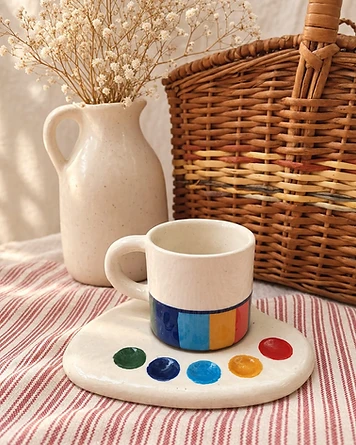
The Bow Plates break that rule on purpose. They are shaped like a ribbon: a soft central dip where a bow would be tied, with flared ends that lift into two points. They are glazed in pink, red and classic white, and they exist to be noticed.
The shape
A bow is a shape everyone already knows. It is the shape on a gift, on a hair ribbon, on the box of something you were given as a child. Because it is so familiar, a plate shaped like one reads instantly — you do not need to work out what you are looking at, which means the object lands as a feeling rather than a form.
The centre dips, so it holds something: three chocolates, a slice of cake, a handful of almonds. The ends flare and rise slightly, which means it also catches the small things you would otherwise put straight down on a table. It is a decorative shape that has been given a job.
Why playful is not unserious
The assumption behind most neutral tableware is that playfulness is for children. It is the same assumption that keeps the good china in the cabinet: the idea that objects should be appropriate to the occasion, and that an ordinary day is not an occasion.
We think this is backwards. An ordinary day is exactly the occasion. The plate that makes a Tuesday afternoon feel less like a Tuesday afternoon has done more for you than a plate that was saved for guests who may or may not come.
A bow plate is still a plate. It is stoneware, hand-glazed, fired twice, dishwasher-safe, and hard enough to be used carelessly. The playfulness is in the form, not in the quality.
What to put on it
Desserts are the obvious answer: a slice of cake, two gulab jamun, a scope of ice cream with something on top. Chocolates, when they are being handed around. Biscuits with the evening tea. Dry fruits, when the plate is going to sit on a coffee table for an hour and needs to look considered.
Then there is the second life of this plate, which is not food at all. It is the plate you put your rings on at night. The one that holds the keys, the hair pins, the earrings you took off in the hallway. A small, pretty thing doing small, pretty work.
On the table
Two of these in the middle of a table with a cup of tea each is a composition. One of them next to a stack of neutral dinner plates is a nice kind of contradiction: the serious plate and the playful one, side by side, doing the same job.
They also make a table look less staged. A perfectly matched setting looks like a photograph. A setting with one unexpected plate in it looks like a home.
Care
Hand-wash or dishwasher, both fine. Stack them gently — the flared ends are the part to look after, since they are the thinnest part of the form. A soft cloth between plates when they are stacked will protect those points for years.
The point
A table does not need to be serious to be beautiful, and it rarely becomes beautiful by being serious. One playful piece in a setting of considered neutrals gives the whole table a personality that no amount of matching can create. Start with a bow.
See it in the collection.
— The HomeofTan Editorial