
Pomegranate Bowls: The Blue Bowl That Holds Fruit and Festivals
Shaped like a pomegranate, crowned, and glazed in a rich royal blue. A small bowl with a big personality — and a longer history than you might expect.

Of all the shapes a bowl can take, the pomegranate is the most loaded. It is fruit, ornament and idea at once, and it has been painted onto walls, woven into textiles and printed onto cushions for thousands of years. Making a bowl out of it is not a novelty. It is a decision to carry something old into a modern home.
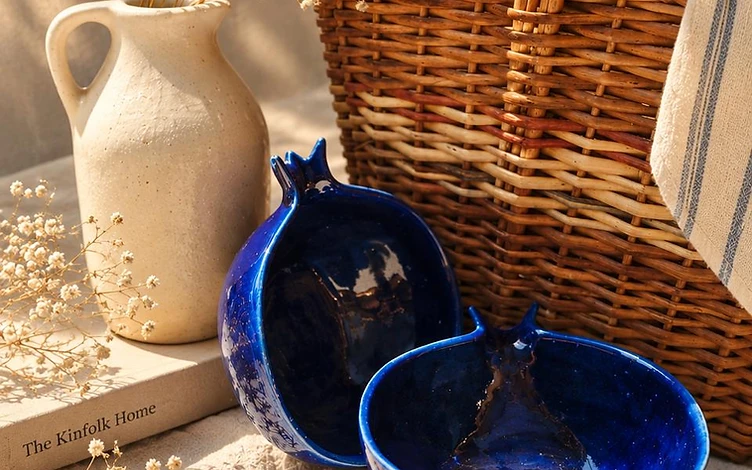
The Pomegranate Bowls are small stoneware bowls shaped like the fruit, with a crown at the top and a rich, glossy royal blue glaze. Eleven centimetres across, seven high, deep enough to hold a proper handful of something.
The shape and the crown
A bowl is normally judged on its curve: wide enough to eat from, deep enough to hold, stable enough not to tip. This one keeps all of that and adds a crown at the top, which is the detail that turns a vessel into a character.
The crown is also useful. It gives the fingers something to hold when the bowl is being carried across a room. It catches the light. And it means the bowl reads as something the moment it is put down on a table, which is more than most small bowls can claim.
The blue
Royal blue glaze on stoneware is a difficult thing to get right. Too dark, and the bowl reads as a black object in a dim room. Too bright, and it looks like plastic. This one is deep and glossy, with light pooling in the curves so the form stays legible even across the room.
Blue is also why the bowl works on almost any table. Against cream and linen it reads as a jewel. Against dark wood it reads as water. Against other blues — the sky blue and sage green of our plate sets — it reads as the deep end of the same family.
Anar, and why the fruit travels
In India the pomegranate is not just a fruit. It is a symbol of abundance and fertility, a shape that turns up at weddings and at housewarmings, and the fruit itself is the one that gets scattered across thresholds and gifted in season. The name travelled too: anar became pomegranate, and granada, and grenade, one of the most widely borrowed words there is.
Which is to say: a pomegranate-shaped bowl arrives with associations. This one does not lean on them heavily. It is a small, elegant object that happens to be shaped like the fruit. But the associations are there, quietly, for anyone who knows them.
Dry fruits, nuts and the festive table
Its natural habitat is a coffee table in December, or a Diwali table, or a table on the day a house is full of relatives and someone has put out dates, cashews and kaju katli. It is exactly the right size for the dry fruits, and exactly the right colour for the setting.
In a smaller moment it holds nuts, chocolates, mithai, or the sweets that never make it to a plate. It also does the other job bowls do: keys by the door, earrings on a dresser, a candle that has been lit once and is remembered.
For gifting
A blue bowl with a crown on it is easy to give. It suits Diwali, weddings, a new home, and the friend who has everything and notices good objects. Two of them, one for the giver and one for the given, is a well-known way of solving the problem of wanting to keep the thing you bought as a gift.
Care
Stoneware, hand-glazed, fired twice, dishwasher-safe. Wash by hand when you can. Do not stack bowls inside each other if you can avoid it — the crown of one bowl against the belly of the next is where chips live.
The point
Objects that carry meaning usually look like they are carrying it. This one does not. It is a bowl, small and useful, that happens to be shaped like a fruit with a long memory. Which is the best kind of heritage: the kind you can also put nuts in.
See it in the collection.
— The HomeofTan Editorial