
A Guide to Glaze Finishes (Glossy, Matte, and Everything Between)
The finish of a glaze is not a detail — it is the whole personality of the ceramic. A short guide to what glossy, matte, and textured glazes do, and how to choose between them.
When you choose a ceramic, you are choosing a glaze finish as much as a colour or a form. The finish — glossy, matte, satin, textured — is the surface your hand and your eye will live with for years. It is the personality of the piece, and it shapes how the ceramic feels in use more than any other single quality.
Most people choose a ceramic for its colour. That is a mistake. The colour fades into the background within a week. The finish is what you keep noticing — in the morning light, under the kitchen lamp, after years of washing. Here is a guide to the main finishes, and what each one does.
Glossy
A glossy glaze is smooth, reflective, and bright. Light bounces off it, which makes the colour read as vivid and clean. A glossy bowl looks sharp, modern, and easy to keep clean — the smooth surface resists stains and wipes down without effort.
Glossy is the finish of the busy kitchen. It is practical, it is cheerful, and it shows off colour well. Its weakness is that it shows everything — water marks, fingerprints, the smallest scratch. A glossy glaze is high-maintenance in the way a polished car is: it looks best when it is clean, and it needs to be kept clean to look its best.
Choose glossy if you want your ceramics to read as bright and crisp, and if you do not mind wiping them down. Avoid glossy if you are bothered by water spots or if you want a surface that ages quietly.
Matte
A matte glaze is soft, non-reflective, and warm. Light is absorbed rather than bounced, which makes the colour read as muted and organic. A matte bowl feels different in the hand — there is a slight texture, a warmth, a sense that the surface was made rather than manufactured.
Matte is the finish of the lived-in table. It hides water marks, it softens with use, and it reads as calm rather than sharp. Its weakness is that some matte glazes can hold onto stains more readily than glossy ones — particularly on the inside of cups and bowls, where tannins from tea and coffee can leave a shadow over years.
Choose matte if you want your ceramics to feel warm, organic, and quiet. It is the finish that ages best, because it is designed to look good even when it is not pristine. Most of our pieces are matte, for this reason.
Satin
A satin finish sits between glossy and matte. It has a soft sheen — not the hard reflection of a gloss, but not the flat absorption of a matte either. It is the most forgiving finish: it hides marks better than gloss, and it resists stains better than matte.
Satin is the quiet all-rounder. It does not have the drama of a high gloss or the tactility of a deep matte, but it does everything well. If you are unsure, satin is the safe choice — it will not surprise you, in either direction.
Textured and reactive
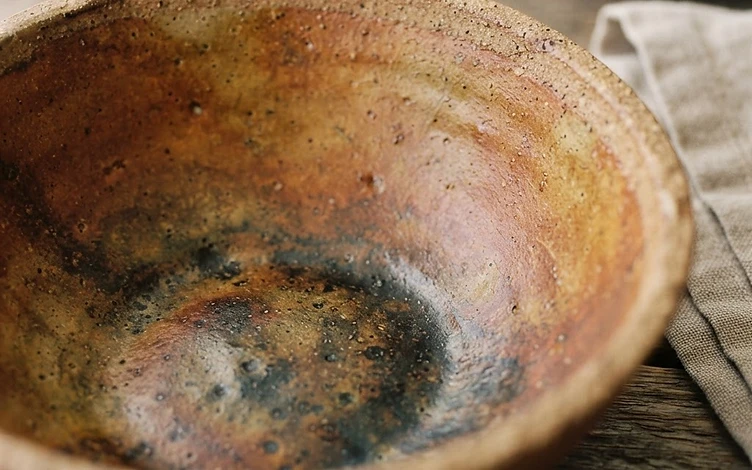
Beyond the three main finishes, there are textured and reactive glazes — glazes that move in the kiln, pool in the curves, break thin on the edges, and develop crystalline spots or variegation. These are the glazes that look most "alive," because no two pieces are identical.
A reactive glaze is the opposite of a flat, even colour. It changes across the surface of the piece — darker where it pools, lighter where it thins, sometimes a different colour entirely where it breaks over an edge. This variation is not a flaw. It is the evidence that the glaze was melted and moved, that it is glass and not paint.
Choose textured and reactive glazes if you want ceramics that look made rather than printed. These are the glazes that reward close looking — the ones you will still be noticing, in the light, in twenty years.
How to choose
Do not choose a glaze finish from a photograph. If you can, hold the piece. Run your thumb across the surface. A glossy glaze will feel slick and cool. A matte glaze will feel soft and warm. A reactive glaze will feel uneven, alive, slightly different every time you touch it.
The finish is the part of the ceramic you will touch most. Choose it for the hand, not just the eye. The eye is easily fooled. The hand is not.
— The HomeofTan Editorial