
A Field Guide to Caring for Your Ceramics
Good ceramics are made to be used, not babied. But a little knowledge keeps them looking good for decades instead of months. Here is what actually matters.
There is a myth that good ceramics are fragile. They are not. A well-made stoneware bowl, fired to the right temperature, is harder than the steel of most kitchen knives. It will outlive you. What it will not survive is being treated carelessly — being stacked badly, being shocked by temperature, or being washed with something abrasive.
The good news is that caring for ceramics is not complicated. It comes down to five things, and none of them require special equipment.
1. Thermal shock is the real enemy
Ceramics do not break from heat. They break from sudden changes in heat. Taking a bowl from the fridge and putting it into a hot oven is the single most common way to crack a piece — not because the bowl is weak, but because one part of it expanded faster than the other.
The rule is simple: let temperature changes happen slowly. Do not move a cold piece straight into a hot oven. Do not plunge a hot piece straight into cold water. If you are warming something, start the piece in a cold oven and let it heat with the room. If you are washing something hot, let it cool first.
2. How to wash them
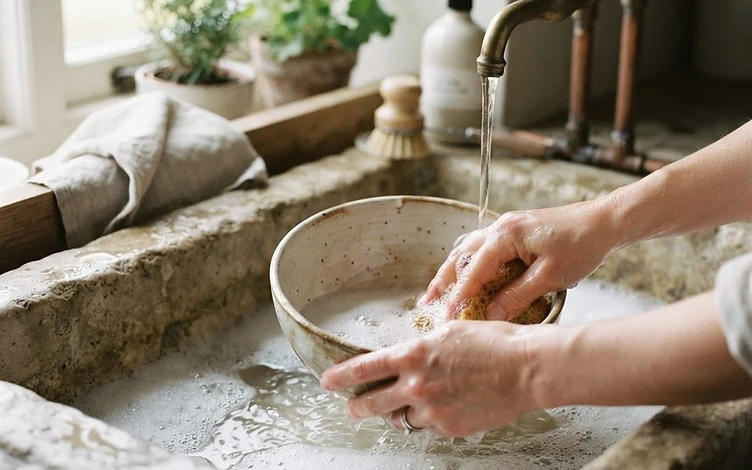
Hand-washing is best, but it is not the only option. Most well-fired stoneware is dishwasher-safe — the glaze is sealed, the body is vitrified, and the detergents will not damage it. What will damage it is other ceramics.
The danger in a dishwasher is not the water or the soap. It is the rattling. Two ceramic pieces vibrating against each other in a dishwasher will chip each other over time. If you use the dishwasher, load with space between pieces, and never let a cup rest against a plate.
For hand-washing, use a soft sponge and warm water. Avoid steel wool, avoid scouring powders, and avoid leaving pieces to soak for hours — prolonged soaking can dull a matte glaze over time.
3. How to stack them
Stacking is where most damage happens in the home, not in the sink. The rim of a plate resting on the rim of the plate below it is a recipe for chipping — a small movement, and the two hard edges meet.
The fix is simple: put something soft between them. A circle of felt, a square of linen, even a paper napkin. Anything that breaks the contact between the two glazed surfaces. This is especially important for pieces with an unglazed foot, which is rougher and will scratch the piece below it.
Stack no more than four plates high. The weight of a tall stack puts pressure on the bottom piece, and a tall stack is more likely to topple.
4. Stains and marks
Over time, you may notice grey marks on a light-coloured glaze — usually from cutlery, not from the ceramic itself. These are not damage. They are metal deposits, and they come off with a gentle ceramic hob cleaner or a paste of baking soda and water.
Tea and coffee can stain unglazed or matte interiors over years. A paste of bicarbonate and water, left for an hour and rinsed, will lift most of it. Do not use bleach — it can dull the glaze.
5. When a piece chips
A chip is not the end. A small chip on the rim can be sanded smooth with fine sandpaper so it is no longer sharp, and the piece remains perfectly usable. A chip on the foot should be sanded so it does not scratch the table or the piece below it.
If a piece cracks all the way through, retire it from hot food — the crack can harbour bacteria — but keep it. A cracked bowl is still a bowl for keys, for fruit, for the small objects of a life. Good ceramics are too good to throw away over a crack.
The underlying principle
Ceramics are made to be used. The worst thing you can do to a good bowl is keep it in a cabinet. Use it, wash it, stack it carefully, and let it age. A ceramic that has been used for twenty years has a depth that a new one does not — the glaze softens, the edges round, and it becomes yours. That is the whole point.
— The HomeofTan Editorial