The Quiet Art of the Empty Surface
An empty surface is not a failure of decoration. It is a choice — and a surprisingly difficult one to make well.
Walk into most homes and you will see the same thing on every surface: a collection of objects, arranged to fill the space. A console table with a lamp, a stack of books, a bowl, a candle, a small plant, a framed photo. A shelf with books pushed to the edges and a gap filled with a vase. A kitchen counter with a knife block, a toaster, a jar of utensils, a fruit bowl, and a kettle.
We are afraid of the empty surface. We treat it as a problem to be solved, a gap to be filled, a silence to be broken. And so we fill it, and we fill it, and then we wonder why our homes feel restless.
The full surface and the tired eye
A full surface is not a styled surface. A full surface is a noisy surface. The eye lands on it and does not know where to rest, so it does not rest at all — it moves on. The room feels busy without ever feeling alive.
This is the paradox of decoration: the more you add, the less you see. Each object competes with the next, and the result is that none of them register. They become a texture rather than a collection of things. You stop seeing the bowl because it is surrounded by six other things that are also asking to be seen.
What an empty surface does
An empty surface does the opposite. It gives the eye a place to land. It lets the room breathe. It creates a kind of visual silence that makes everything around it feel more deliberate.
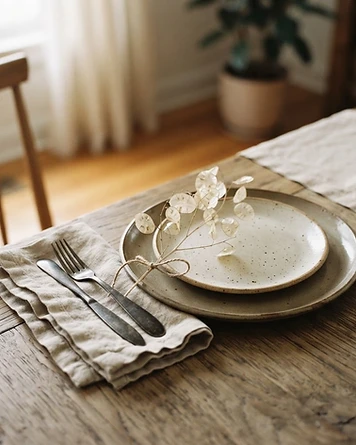
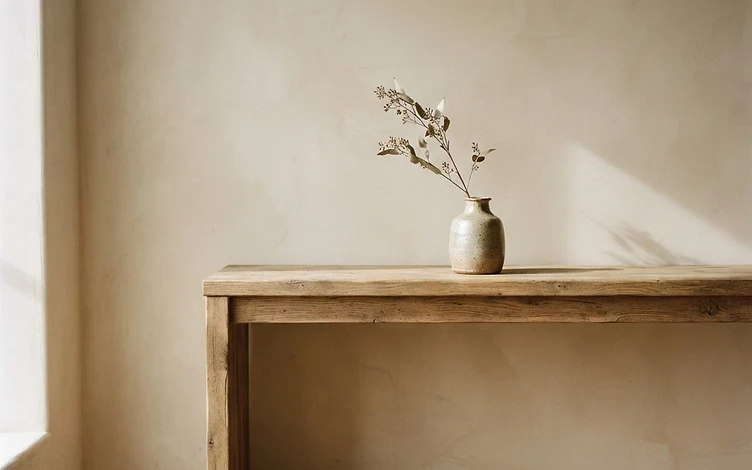
A console table with a single object on it — one bowl, one vessel, one small sculpture — is not a console table that is unfinished. It is a console table that has been edited. The single object is doing more work than any five objects could, because it has been given the space to be seen.
Why it is hard
Editing a surface down to one thing is harder than filling it. Filling is instinct — we see a gap and we close it. Editing is restraint. It requires you to look at a surface full of objects you chose, that you like, that you paid for, and to remove most of them.
It requires you to trust that the room does not need to be completed. That the surface is not waiting for something. That the emptiness is the thing.
A small exercise
Pick one surface in your home — a console, a side table, a shelf. Remove everything from it. Everything. Then put back one object. Just one. The one you would keep if you could keep only one.
Leave it for a week. See how it feels. If the surface feels lonely, add one more object. If it feels right, do not add anything. The goal is not to achieve emptiness for its own sake. The goal is to find the point where the surface feels considered rather than crowded.
For most people, that point is one or two objects, not seven. We have simply been taught to fill, and so we fill.
The point
An empty surface is a kind of luxury. It is the luxury of not needing to prove, through objects, that you have taste. It is the confidence to let a room be quiet. And a quiet room, it turns out, is the room you actually want to be in.
— The HomeofTan Editorial