
How to Build a Home Bar Without a Bar
You do not need a bar cart, a dedicated corner, or a collection of forty bottles. You need a tray, three bottles, and one good glass.
The home bar has become a category of consumption. There are bar carts, bar cabinets, bar shelves, bar tools, bar glasses, bar books, and bar accessories for the bar tools. The implication is that to have a drink at home, you must first build a bar.
You do not. A home bar is not a piece of furniture. It is a small, considered collection of things that let you make a drink without leaving the room. You can build one on a tray, on a shelf, or in a corner of a sideboard. The furniture is irrelevant. The thinking is everything.
Here is how to build a home bar without buying a bar.
Start with the tray
A tray is the single most useful object in a home bar, because it defines the bar without building one. A tray on a sideboard says: this is where the drinks live. It contains the collection, it is portable, and it looks intentional without looking like you tried.
Choose a tray that is plain and textured — wood, stone, or a natural fibre. Avoid mirrored trays, which show every watermark and look like a hotel lobby. The tray is a surface, not a feature.
The three bottles
You do not need a wall of bottles. You need three, chosen for how you actually drink. For most people, that is:
One spirit you drink neat or on the rocks. Whisky, rum, gin — whatever you reach for when someone arrives. One bottle, the one you like.
One spirit for mixing. The one you use in a simple highball or a basic cocktail. For a lot of homes, this is the same bottle as the first. That is fine. If it is not, add one more.
One modifier. Vermouth, bitters, a liqueur. The thing that turns a spirit into a drink. One is enough to start.
Three bottles. That is a bar. You can add more over years, but you should never start with more. A bar with three bottles that you use is better than a bar with thirty that you don't.
The one good glass
Most home bars fail at the glassware. People either have nothing — they serve a whisky in a water glass — or they have everything — six different glasses for six different spirits, most of which they never use.
The answer is one. One style of glass, in a quantity that lets you serve two people. A short, heavy tumbler works for almost everything — spirits on the rocks, a simple highball, even water. A single, well-made tumbler, in a set of two or four, covers ninety percent of what a home bar is asked to do.
Choose a glass with weight. A glass that feels good in the hand makes a drink feel like a drink. This is the one place where the object really matters — you hold it, you bring it to your mouth, you feel it. A thin, light glass makes the drink feel cheap. A glass with presence makes the same drink feel like an occasion.
The small things
A bottle opener. A small jug for water or mixers. A linen napkin or a small cloth for wiping. That is it. You do not need a shaker, a jigger, a strainer, a muddler, and a channel knife — unless you actually make cocktails, in which case you already know what you need.
The small things should live on the tray, so the bar is always ready. The point of a home bar is that it is there. If you have to assemble it every time, it is not a bar — it is a project.
What it looks like
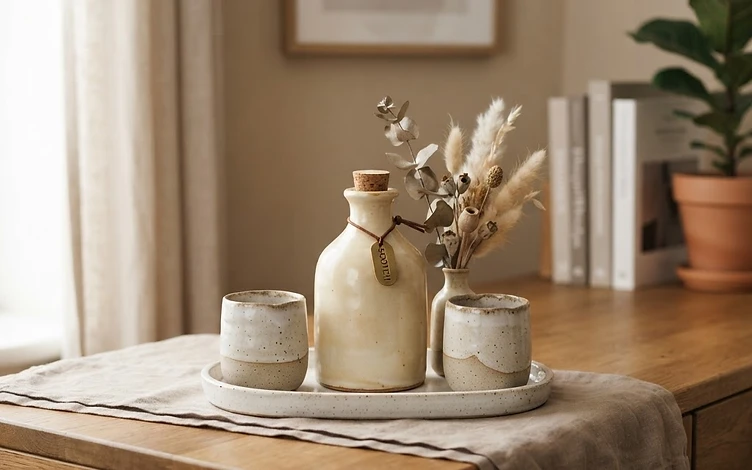
A tray on a sideboard. Three bottles. Two tumblers. A small jug. A cloth. A bottle opener. That is a home bar. It takes up the corner of a piece of furniture you already own. It cost almost nothing to assemble. And it means that when someone arrives, or when the evening turns, you can make a drink without leaving the room — which is, when you think about it, the entire reason to have a home bar in the first place.
— The HomeofTan Editorial