How to Set a Table Without a Tablecloth
A bare table is not an unfinished table. Done well, the absence of a cloth is the strongest styling decision you can make. Here is how to make it work.
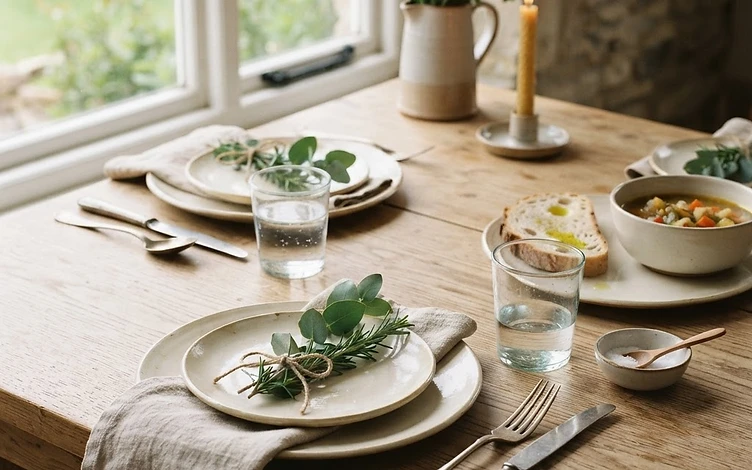
There is a habit, particularly in homes that have inherited it, that a table is not finished until it is covered. The cloth goes on first, and everything else is built on top of it. The table itself — the wood, the stone, the surface — disappears, and what you are really styling is the cloth.
A bare table is a different proposition. It says: this surface is good enough to be seen. It is a statement of confidence in the table itself, and in the objects you are putting on it. Done well, the absence of a cloth is the strongest styling decision you can make. Done badly, it looks cold. Here is how to make it work.
Start with a surface worth showing
The first rule of the bare table is that the table has to earn it. A scratched, stained, or ugly table is not improved by being uncovered — it is exposed. If your table is not a surface you want to look at, use a cloth. There is no shame in it.
But if your table is good — warm wood, honest stone, even a clean painted surface — then the cloth is hiding the best thing in the room. Pull it off. Let the table be the table.
Use a runner, not a cloth
If a fully bare table feels too bare, the middle ground is a runner. A runner in natural linen, in a width that covers about a third of the table, gives you the softness of a cloth without hiding the surface. It defines a strip down the centre where the styling lives, and it leaves the wood visible on either side.
Choose a runner in a solid, textured neutral — oat, clay, stone. Avoid prints. The runner is a frame, not a feature. Its job is to let the table and the plates be seen, not to compete with them.
Let the plates sit on the surface
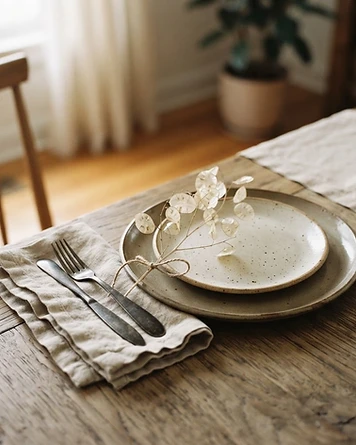
On a cloth, plates float — the cloth softens everything, and the plate reads as part of a continuous soft surface. On a bare table, plates sit. The hard base of the plate meets the hard surface of the table, and the contrast is the point. The plate becomes an object, not a layer.
This is where the plates matter more than ever. On a bare table, a cheap plate looks cheap, because there is nothing to soften it. A well-made stoneware plate, in a glaze with depth, reads as an object that was placed with intention. The table is the stage, and the plate is the actor. Give it a stage that lets it act.
Add one soft thing
A bare table with hard plates on hard wood can tip into cold. The fix is one soft element. A linen napkin, folded loosely. A sprig of something green. A length of textured fabric under the plates. One soft thing, placed with care, warms the whole table without covering it.
The mistake is to add too many soft things. One is enough. Two is a collection. Three is a cloth by another name. The point of the bare table is restraint, and the soft element is there to prove the restraint was a choice, not an oversight.
What the bare table says
A bare table says something a clothed table cannot. It says: I trust this surface. I trust these objects. I do not need to hide anything. It is a table that has been edited down to its essentials — the surface, the plate, the cup, and one small thing that makes it feel lived in.
If your table is worth showing, show it. The cloth is a habit. The bare table is a decision.
— The HomeofTan Editorial