
How to Stack Plates (So They Last Twenty Years)
Most ceramic damage happens in the cupboard, not the sink. A short, practical guide to stacking, storing, and keeping your plates for decades.
Most people think their plates get damaged in the sink. They do not. They get damaged in the cupboard. The sink is where ceramics get clean. The cupboard is where ceramics get chipped, scratched, and slowly ruined — one small, invisible meeting of two hard edges at a time.
Stacking is the unglamorous heart of ceramic care. It is also the easiest thing to get right, and almost everyone gets it wrong. Here is how to stack plates so they last twenty years instead of two.
The problem with the straight stack
When you stack plates directly on top of each other, the rim of the lower plate meets the rim of the upper plate. Two glazed edges, hard against hard. The stack shifts — and it always shifts, when you pull a plate, when you close the door, when the house vibrates — and the two edges grind. Over months, this grinding chips the rims. Over years, it dulls them.
The worst version is the unglazed foot. The bottom of most plates has an unglazed ring — the foot ring, where the potter rested the piece in the kiln. This ring is rough, almost like fine sandpaper. When it sits directly on the glazed surface of the plate below, it scratches it. Every time the stack moves, it scratches a little more. This is why your plates have faint grey rings on the face of them. It is not staining. It is the foot ring of the plate above.
The fix: break the contact
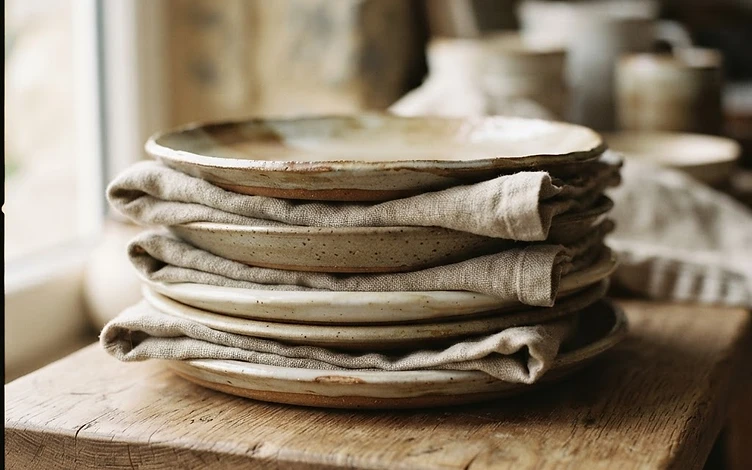
The solution is simple, and it is the single most effective thing you can do for your ceramics. Put something soft between the plates. A circle of felt. A square of linen. A paper napkin. Anything that breaks the contact between the two hard surfaces.
You do not need to line every plate. You need to line between them. A small, soft barrier between each plate in the stack stops the grinding entirely. The rims no longer meet. The foot ring no longer scratches. The stack can shift all it likes, and nothing happens, because the hard edges are no longer touching.
This is the difference between plates that look new in five years and plates that look new in twenty. It costs almost nothing. It takes five minutes. And almost nobody does it.
How high to stack
Stack no more than four plates high. A tall stack puts the full weight of the upper plates on the rim of the bottom plate, all day, every day. It also makes the stack unstable — a tall stack is more likely to topple when you pull a plate from the middle.
Four is the practical maximum. If you have more plates than four to a stack, split them into two stacks. The bottom plate of a four-high stack is carrying four times its own weight on its rim. The bottom plate of an eight-high stack is carrying eight. The rim was not designed for that.
Where to put the heavy ones
The heaviest plates go at the bottom of the stack, the lightest at the top. This is the opposite of what most people do, because most people stack in the order they unload the dishwasher. But a light plate on the bottom, with a heavy plate above it, is a light plate being slowly cracked by the weight of the heavy one.
Heavy at the bottom, light at the top. It is a small thing. It matters.
The underlying principle
Ceramics do not die of old age. They die of contact — with each other, with hard surfaces, with the small daily vibrations of a house being lived in. The art of keeping them is the art of managing that contact. Break the contact between hard surfaces, keep the stacks short, and put the heavy ones at the bottom. Do those three things, and the plates you buy today will be the plates your kitchen still has in twenty years — still useful, still good-looking, and carrying the quiet evidence of two decades of meals.
— The HomeofTan Editorial