
Why Stoneware, Not Porcelain
Porcelain is fine, white, and delicate. Stoneware is warm, earthy, and strong. We chose stoneware — and the choice says something about how we think a home should feel.
When most people picture fine ceramics, they picture porcelain. White, thin, translucent at the rim, the material of teacups and formal dining. Porcelain is the ceramic of the special occasion — the cabinet, the guest, the holiday table that comes out twice a year.
We make stoneware instead. The choice is not accidental, and it is not about cost. It is about how we think a home should feel, and what we think the objects in it should do.
What stoneware is
Stoneware is a ceramic fired at a high temperature — usually between 1200 and 1280 degrees — until the clay body vitrifies, becoming dense, non-porous, and hard. The word "stone" is literal: a well-fired stoneware bowl has more in common with a river stone than with the soft, porous earthenware most people are familiar with.
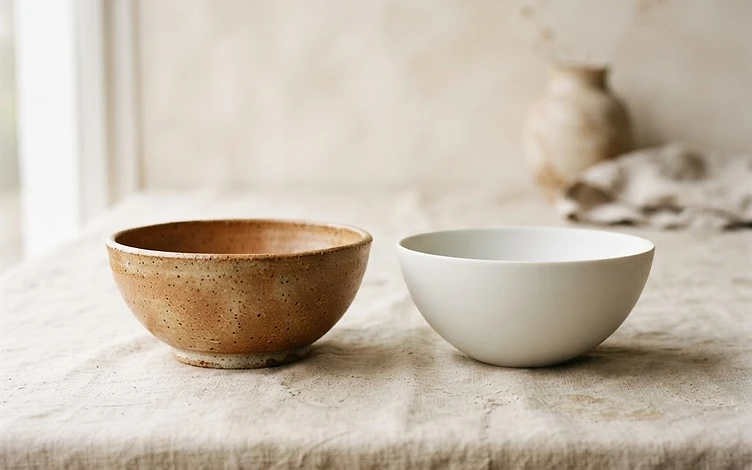
Stoneware is usually thicker than porcelain, and it is usually coloured — the clay itself is often warm, grey, or brown, and the glaze sits on a body that has its own character. Where porcelain hides the clay behind whiteness, stoneware lets the clay show through. You can see the material. You can feel it.
The argument for warmth
Porcelain is beautiful, but it is cold. A white porcelain plate on a white table reads as elegant, but it also reads as distant — as a table that is being observed rather than lived at. The translucency that makes porcelain prized is the same quality that makes it feel a little untouchable.
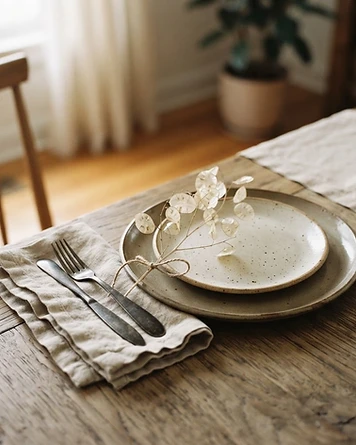
Stoneware is the opposite. It is opaque, warm, and grounded. A stoneware plate on a wooden table reads as a plate that is about to be eaten from, not a plate that is being displayed. The colour of the clay, the depth of the glaze, the slight irregularity of a hand-thrown form — these are qualities that invite the hand, not just the eye.
For a home — as opposed to a restaurant, or a showroom — warmth matters more than refinement. The objects you use every day should make the room feel lived in, not staged. Stoneware does that. Porcelain, for all its beauty, does the opposite.
The argument for strength
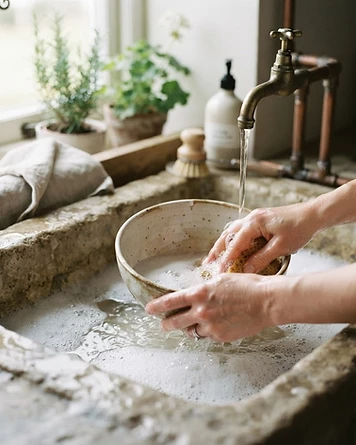
There is also a practical case. Stoneware is harder than porcelain, and it chips less easily. A stoneware plate, dropped on a wooden floor, has a better chance of surviving than a porcelain one. A stoneware rim, knocked against another plate in the sink, is more likely to shrug it off than to chip.
This matters because the objects in a home are going to be used. They are going to be stacked, washed, moved, dropped. A ceramic that cannot survive the ordinary life of a kitchen is a ceramic that ends up in the cabinet, which is the worst fate for a good object. We make stoneware because we want our ceramics to be used — daily, carelessly, well — and to survive it.
What the choice says
The choice of material is a choice about the kind of home you are making. Porcelain says: this is a special occasion. Stoneware says: this is an ordinary day, and the ordinary day deserves a good object. Porcelain says: look at this. Stoneware says: use this.
We are interested in the ordinary day. The ordinary day is where most of life happens, and it is where the objects you touch most often do their quiet work. A stoneware cup, held every morning, ages into something better than new. A porcelain cup, kept in the cabinet, stays exactly as it was the day it was bought — perfect, and unused.
We would rather make the cup that gets used.
— The HomeofTan Editorial