
The Table as a Canvas
A dining table is the largest flat surface in most homes, and the one we use the least imaginatively. A short argument for treating the table as a place to compose, not just a place to eat.

The dining table is, in most homes, the largest flat surface in the house. It is also, in most homes, the surface that gets the least thought. It is either bare — a wooden plane waiting for a meal — or covered — a meal in progress, a mess being made. Between meals, it is often a holding area for mail, keys, and the debris of the day.
This is a waste. The table is a canvas. It is the one surface in the home large enough to hold a composition, and the one surface that everyone in the house looks at every day. Treating it as a place to compose — not just a place to eat — changes the room it sits in.
The table between meals
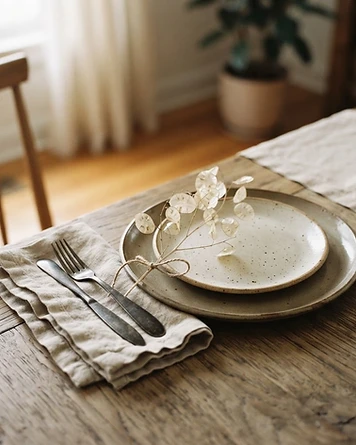
The mistake is to think the table only exists when it is set. The table exists between meals, and between meals is when it has the most visual impact. An empty table with a single object on it — a bowl, a vase, a stack of plates — is doing more work than a table that is cluttered or a table that is bare.
The question is not "what do I put on the table for dinner." The question is "what does the table look like when no one is eating." If the answer is "nothing" or "everything," the table is being wasted. A single, considered object on a bare table turns the table from a surface into a statement.
Composition, not decoration
The word "composition" is deliberate. A table is not decorated — it is composed. Composition means thinking about balance, about negative space, about the relationship between objects. A bowl on the left, a vase on the right, and nothing in between is a composition. A bowl, a vase, a candle, a stack of books, a plant, and a salt shaker is clutter.
The rule is the same as in any visual art: every object you add must earn its place. If you cannot say why an object is there, it should not be there. A table with three objects that each have a reason is a composed table. A table with ten objects that are there because they had nowhere else to go is a storage surface.
The everyday composition
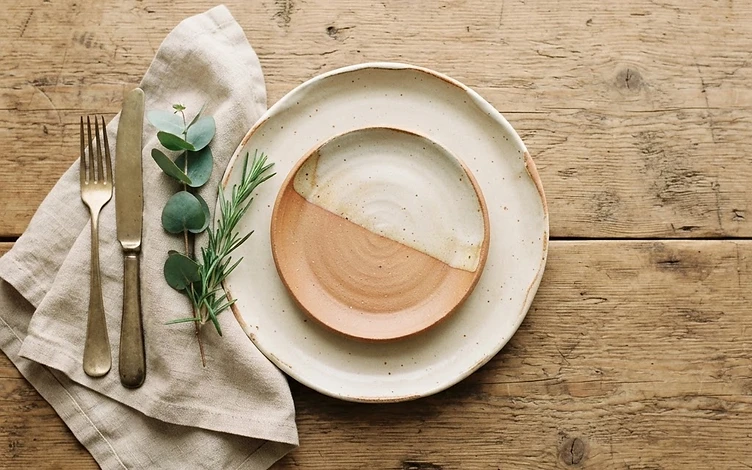
The compositions that matter most are the everyday ones — the ones you live with between meals, not the ones you build for a guest. A stack of three plates, a small bowl with fruit, a linen runner. That is a composition. It takes thirty seconds to set, it lasts a week, and it makes the table a part of the room rather than a gap in it.
The point is not to make the table look like a photograph. The point is to make the table look like someone cares about it — because the table is the centre of the room, and a room whose centre is cared for feels different from a room whose centre is ignored.
Start with one object
If your table is bare, put one object on it. Not a set, not a collection — one. A bowl you like. A vase with a single stem. A stack of three plates. Leave it for a week. See how the room feels. If the table feels lonely, add one more. If it feels right, stop.
The table is a canvas, but a canvas does not need to be full. It needs to be considered. A considered table — even a nearly empty one — changes the room. And the room, it turns out, is where you live.
— The HomeofTan Editorial