
What Glaze Actually Is (and Why It Matters at the Table)
Glaze is not paint. It is a thin layer of glass, melted onto the clay, that makes a bowl safe to eat from and a pleasure to look at. A short guide to the most misunderstood part of a ceramic.
If you have ever looked at a ceramic bowl and wondered why the inside is smooth and the outside is rough, or why one bowl stains and another does not, or why a glaze looks the way it does — the answer is glaze. And glaze, despite being the most visible part of a ceramic, is also the most misunderstood.
Glaze is not paint. Paint sits on the surface. Glaze becomes the surface. It is a thin layer of glass, chemically bonded to the clay beneath it, that seals the ceramic and gives it its colour, its texture, and its character. Understanding what it is changes how you choose ceramics, and how you live with them.
What glaze is made of
A glaze is a recipe of minerals. The three main ingredients are silica, which is the glass-former — the stuff that actually melts into glass. A flux, which lowers the melting temperature of the silica so it can be fired in a kiln. And a stabiliser, usually alumina, which keeps the glaze from melting so much that it runs off the pot.
On top of that base, a glaze carries colour — iron for browns and greens, cobalt for blues, copper for reds and greens, titanium for whites. The same base glaze, with different colourants, becomes a different surface. And the same colourant, in a different base, becomes a different colour. Glaze chemistry is a deep, finicky craft, and two potters using the same recipe will get different results — because the firing, the clay, and the kiln all have a say.
Why glaze matters
Glaze is doing two jobs at once, and both of them matter to you.
The first job is functional. The glaze seals the clay. An unglazed ceramic is porous — it absorbs water, it stains, it can harbour bacteria. A glazed ceramic is sealed: the glaze fills the pores of the clay with glass, so the surface is non-porous, hygienic, and cleanable. This is the difference between a bowl you can eat from and a bowl you cannot.
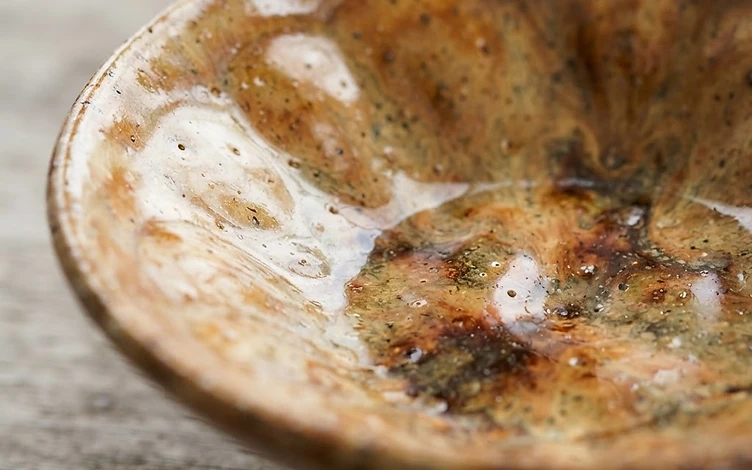
The second job is aesthetic. The glaze is where the maker's decisions about colour, texture, and feel become physical. A glossy glaze reflects light and reads as clean and modern. A matte glaze absorbs light and reads as soft and organic. A glaze with depth — where the colour pools in the curves and thins on the edges — reads as alive, because it changes as you turn the piece. The glaze is the personality of the ceramic.
Glossy, matte, and everything between
The texture of a glaze is a choice, and it shapes how the ceramic feels in use. A glossy glaze is smooth, easy to clean, and shows every mark — it is the glaze of a busy kitchen. A matte glaze is softer, warmer to the touch, and hides water marks — it is the glaze of a table that wants to be touched. Neither is better. They are different answers to the same question.
The depth of a glaze is the other thing to look for. A cheap glaze is a flat, even colour — it looks the same everywhere, like paint. A good glaze has variation — it pools in the bottom of a bowl, it breaks thin and bright on a rim, it moves with the form. This variation is not a flaw. It is the evidence that the glaze was melted and moved, that it is glass and not paint. It is what makes a ceramic look made rather than printed.
How to read a glaze
Next time you are choosing a ceramic, do not just look at the colour. Look at the depth. Turn the piece in the light. Does the glaze change — darker in the curves, lighter on the edges? Does it have texture — a soft sheen, a quiet pool, a place where the colour breaks? Does it feel like a surface that was melted, or a surface that was sprayed?
A good glaze is the thing you will live with for decades. The colour you chose in the shop will fade into the background. The depth — the way the light moves in it, the way it pools, the way it ages — is what you will still be noticing in twenty years. Choose for the depth, not the colour. The depth is the glaze. The colour is just the paint.
— The HomeofTan Editorial