
Why We Don't Sell Sets (and Why You Shouldn't Buy Them)
A matched set is the easiest thing to sell and the hardest thing to live with. A small argument for collecting, not matching — and for a table that grows over time instead of arriving all at once.
The matched set is the default of the tableware industry. Six dinner plates, six side plates, six bowls, all identical, all from the same mould, all in the same glaze. You buy it once, in a box, and you have a table. It is the easiest thing to sell, because it is the easiest thing to understand. It is also, we would argue, the hardest thing to live with.
Here is why we do not sell sets, and why we think you should not buy them.
The problem with the set
A matched set is a finished thing. The moment you buy it, your table is decided — today, and for the next ten years. There is nothing to add, nothing to edit, nothing to discover. The table is complete on the day it arrives, and it will be the same table in a decade. It is a solution, not a life.
A set is also fragile in a particular way. Break one plate, and the set is broken. The replacement, if you can find it, is a new plate among old ones — the one bright, unscratched plate in a table of plates that have lived. The set cannot absorb a loss, because the set is the point. The individual plate is not the point. The plate is only a member of the set, and without the set it is nothing.
The case for collecting
A collection is the opposite of a set. A collection is not finished on the day it arrives. It grows. You start with four bowls, and a year later you add two plates, and a year after that a cup that does not match any of them but belongs anyway. The table is never complete, because the table is not supposed to be complete. It is supposed to be lived in.
A collection is also resilient. Break a plate, and the table absorbs it — because the table was never about that one plate. The other plates are different, and the gap is a gap, not a wound. You replace it when you find something worth replacing it with, or you do not, and the table carries on with five. A collection can lose a member and remain itself. A set cannot.
How to start a collection
You start a collection the way you start anything — with one thing. One bowl, or one cup, or one plate. The one you would keep if you could keep only one. Not the one that matches a set — the one you actually like.
Then you wait. You do not buy the rest at once. You live with the one thing, and you notice what it does well and what it does not. You notice that the bowl is perfect for fruit but too shallow for soup, and so the next thing you buy is a deeper bowl. You notice that the cup is good for coffee but you have nothing for tea, and so the next thing is a teacup. The collection grows in response to the life, not in response to a catalogue.
The rule of a collection is that every piece has earned its place. Nothing is there because it came in a box. Everything is there because you chose it, used it, and decided it was worth keeping. A table built this way has a personality that a set can never have — because a set was decided in a shop, and a collection is decided in a home.
What a table of collected things looks like
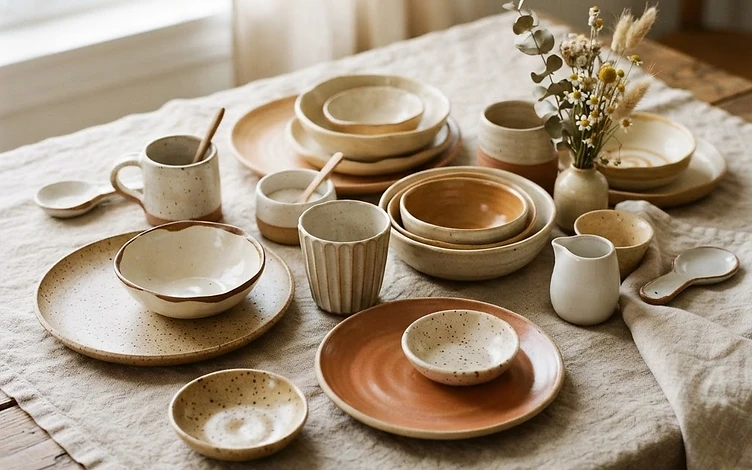
A table of collected things is not a matching table. The plates are in the same family — warm stoneware, natural glazes — but they are not identical. One is cream, one is clay, one has a rim that breaks to a different colour. The bowls are two shapes. The cups do not match the plates. And yet the table looks intentional, because it is. Every piece was chosen. Nothing arrived by default.
This is the table we are interested in. Not the table that was bought in an afternoon, but the table that was built over years. The table that has a story — this bowl from that trip, this cup because the old one broke, this plate because it was the first one and the rest grew around it. A set has no story. A collection is nothing but.
The point
We do not sell sets because we do not believe in sets. We believe in the one thing, chosen well, and the table that grows around it. Start with one. Let it earn the next. And in ten years, you will have a table that is yours — not a table that anyone could have bought, but a table that only you could have built.
— The HomeofTan Editorial