
Why We Fire Twice (and What It Means for the Bowl You Eat From)
Every ceramic you own was probably fired twice. The second fire is the one that makes it safe to eat from. Here is what happens inside the kiln.
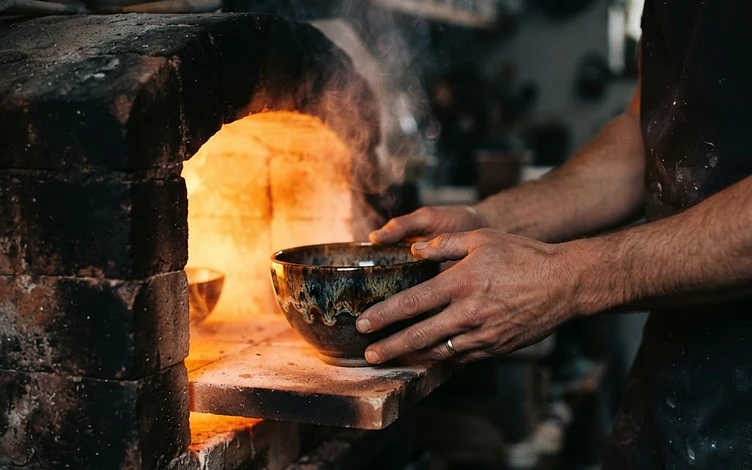
If you have ever held a ceramic bowl and wondered why it doesn't dissolve in water, the answer is heat. Specifically, two rounds of heat. Almost every ceramic you have ever eaten from was fired twice, and the difference between the first fire and the second fire is the difference between a fragile clay shape and a permanent object.
This is not a detail that matters only to potters. It matters to anyone who eats off ceramics — which is everyone — because the second fire is the one that makes a bowl safe, durable, and cleanable. Understanding it changes how you see the objects in your cupboard.
The first fire: bisque
The first firing is called the bisque fire. The potter takes the raw, dried clay — which is fragile, chalky, and would dissolve if you washed it — and heats it slowly to around 1000 degrees Celsius. At that temperature, the chemically bound water leaves the clay, and the clay particles begin to fuse together.
What comes out is called bisqueware. It is hard enough to handle, but it is still porous. If you poured water into a bisque bowl, the water would slowly seep through the walls. It is not yet a vessel. It is a promise of a vessel.
The bisque fire is also the fire that makes the surface ready to accept glaze. The porous bisque drinks the liquid glaze like a sponge, holding it in place until the second fire.
The glaze
Between the two fires, the potter coats the bisqueware in glaze — a liquid suspension of minerals, silica, and fluxes that will, when heated, melt into a thin layer of glass on the surface of the clay. The glaze can be clear, letting the colour of the clay show through, or it can carry its own colour and texture.
This is the moment the object gets its personality. The same bowl, dipped in different glazes, becomes a different object. The glaze is where the maker's decisions about colour, texture, and feel become physical.
The second fire: the one that matters
The second firing is hotter — usually between 1200 and 1280 degrees for stoneware. At this temperature, two things happen at once. The clay body vitrifies: the particles fuse so completely that the clay becomes non-porous, dense, and hard. And the glaze melts into a continuous layer of glass that bonds chemically to the clay beneath it.
This is the fire that makes the bowl a bowl. After the second fire, the object will not absorb water. The surface is sealed, so it will not stain. It is hard enough to resist scratching. It is, for all practical purposes, permanent — short of dropping it on a stone floor, it will outlast you.
Why this matters at the table
When you eat from a twice-fired stoneware bowl, you are eating from a surface that is, essentially, glass bonded to stone. That is why it is hygienic — there are no pores for bacteria to live in. That is why it is durable — the glaze is harder than the steel of your fork. That is why it is cleanable — a wipe removes everything, because there is nowhere for anything to hide.
A bowl that has only been fired once, or fired at too low a temperature, is a different object. It is porous. It stains. It can harbour bacteria in its pores. It chips more easily. It looks like ceramic, but it does not behave like ceramic.
The cost of doing it properly
Firing twice takes more time, more energy, and more skill than firing once. It is one of the reasons well-made ceramics cost more than mass-produced ones. The second fire is where the object earns its permanence — and permanence, it turns out, is worth paying for, because it is the difference between an object you replace in a year and an object you pass on.
When you hold a well-fired bowl, you are holding the result of two journeys through heat. The first made it solid. The second made it permanent. Every meal you eat from it is a small confirmation that someone did the work twice, so you would only have to buy it once.
— The HomeofTan Editorial